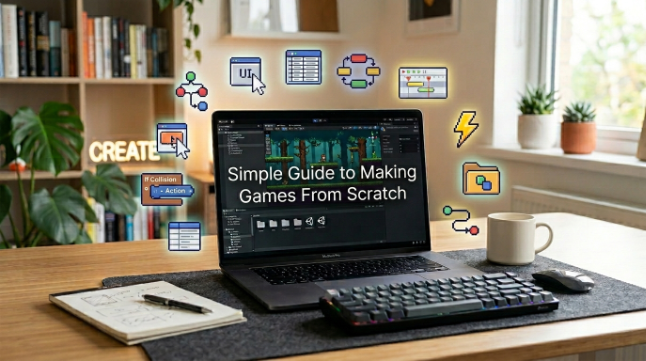
Conceiving and creating games for a system such as the Astrocade is exhilarating but can be daunting if you had “no idea what you were doing”. You might have the greatest game idea in your head, but you don’t know how to turn it into something people can actually play.
This guide breaks the process into easy steps, from selecting a concept and understanding simple programming to working with Astrocade, a game platform that makes game creation easier. Once you finish, you’ll know exactly how to start making your first game and how to develop it further.
Start With Ideas
Any great game begins with an idea. You don’t need a massive story or a huge idea for your first project. Think of some simple games you’ve played and ask yourself what made them fun. A small platform game, puzzle game, racing game or simple adventure can be developed.
Keep your first idea small and feasible. Rather, start with a single character, one level, and a simple objective. It’s a smaller game and so is easier to finish, important if you’re new to game design and don’t want to get overwhelmed.
See also: The Zero-to-Thirty Problem: Scoring Peptide Providers Like a Spreadsheet, Not a Vibe
Learn Basic Coding
You don’t need to be a professional developer to get started. With a few simple programming concepts under your belt, you can understand why characters move the way they do, what happens when you push buttons, and how the game responds to the player. Learn the basics, such as variables, if statements, loops, and functions.
Start small with features, rather than trying to build the whole game at once. For instance, maybe your character can move left and right, or a button changes something on the screen. These bite-sized projects are excellent way to get your coding cracked open and help you gain a little confidence in what you doing.
Choose Game Tools
Choosing the right game engine can make your project so much easier. Popular engine choices include Unity, Unreal Engine, and Godot.Each beginner has different features needs, so they should choose a suitable tool according to their skills and the type of game they want to create.
You’ll also need other material, like graphics, sounds, music, and maybe utilities for doing animation. Don’t feel like you need to do everything yourself from day one. Free or cheap assets can help you concentrate on the game making aspect of game making when you’re making your first game.
Build Your Game
And talking about now, well its time to turn the concept into a playable game. Start with basic components like the player, fundamentals of movement, the rules and the goal of the game. Add features one at a time, and test before moving on to the next.
Your first version doesn’t need to be perfect. Simple graphics also put gameplay first, straightforward gameplay. When you got the game functioning on a very primitive level, then you can add more believable people, tougher levels more sound, more neat little effects, menus and all that as they say in the classics.
Test And Improve
Testing is pivotal in the game development. Play it yourself and watch for bugs, like broken controls, levels that are too hard, missing sounds, or any other weird behavior. It never hurts to have friends or other players finish the game, as they might find issues you didn’t.
Change a few things, then test. Don’t do too much at once!Prioritize the big problems, then the little problems. Doing this sort of testing/debugging/feature-adding cycle will slowly evolve a simple project into a more involved game.
Conclusion
I know coding and making games is intimidating to start with but you can make it slightly easier by approaching it one step at a time. Come up with a small idea, learn some coding, choose some tools, and implement a few features before you add more.You can start playfully with a simple Football Tycoon game that teaches letters.
But most of all, don’t wait until you know everything to get going. It’s your first game, so it’s probably not great, and that’s perfectly normal. Each and every small project is a new lesson, each and every little project is a step closer to building the games you dream of.
FAQs
Can beginners make games from scratch?
Absolutely. Beginner programmers can make basic games with a love of some basics and knowledge of some game engine for beginners that is very simple to use. Start small and at the job learn.
Do I need coding skills to make a game?
Coding is fun to learn and has many practical applications, but you don’t have to be a coding rock star to get started. Learn concepts and by make small games, apply them.
What is the best tool for making games?
Nobody tool is best for every situation. Godot, Unity, or Unreal Engine are some of the most popular options, but which one you should use depends on the type of game you want to make and your skill level.
How long does it take to make a game?
Scale and complexity of the gameplay affect the execution time. A small indie game may be completed in days or weeks, but a large commercial title might require years.
What should my first game be?
Choose a small, do-able project. A regular 2D arcade, puzzle or platformer game makes a good first project because it allows you to concentrate on learning the basics without becoming overwhelmed.