Here’s the number I keep coming back to: zero. Not “20% worse,” not “a few points behind.” Zero out of thirty. That’s what you get when you take the six criteria that actually determine whether a peptide purchase is worth anything, assign points the way the source material implies (0 to 5 each, six criteria, 30 possible), and run it against four research-chemical sellers. I’ll show my work below. But the headline is that this market doesn’t have a close race. It has a cliff.
A note on where the numbers come from before I start throwing tables at you. Every input here traces to a primary source: FDA announcements and drug labeling, peer-reviewed journals indexed on PubMed and PMC, and the U.S. Anti-Doping Agency. I’m not grading anyone’s marketing copy. I’m grading what’s documented.
Why the usual “cheapest wins” math is broken
Most peptide comparison pieces run one calculation: price divided by milligrams. Lowest number wins. That’s a fine formula if every milligram is identical. It’s a terrible formula here, because the thing you’re actually purchasing isn’t milligrams. It’s the probability that the vial contains what the label claims, that buying it doesn’t put you in a legal gray zone, and that a real person is accountable if something goes wrong.
Put quality in the denominator of that equation and the math flips. A cheap listing with an unverified denominator isn’t a bargain. It’s a number you can’t calculate, because you don’t actually know what you’re dividing by.
So instead of price-per-mg, I built a quality-adjusted scorecard: six criteria, weighted by how much each one actually moves the value you receive, scored the way the underlying analysis frames it (0 to 5). Let’s get into the weights first, then the scores, then the total.
2026’s forcing function: the FDA did the math for us
You can’t run this analysis honestly without one 2026 data point sitting at the top. On March 3, 2026, the FDA sent warning letters to 30 telehealth companies over illegal marketing of compounded GLP-1 products [1]. Two specific violations stood out in the agency’s language: implying compounded product was equivalent to the FDA-approved drug, and obscuring who actually compounded it behind private-label branding [1]. FDA Commissioner Marty Makary put a number-free but unambiguous stake in the ground: “It’s a new era. We are paying close attention to misleading claims being made by telehealth and pharma companies across all media platforms, and taking swift action” [1].
That enforcement wave reached beyond GLP-1s into the “research use only” lane covering semaglutide, tirzepatide, retatrutide, BPC-157, and various SARMs. The legal read was consistent: an RUO disclaimer doesn’t exempt a product from drug regulation once the marketing is obviously aimed at humans, and a coded abbreviation on a product name got treated as evidence, not cover. Translate that into value terms and it’s simple. A discount that depends on a label the FDA is actively using against the seller isn’t a discount. It’s a liability you haven’t priced yet.
The six inputs, and what each is actually weighted on
1. Can you verify what’s in the vial? (highest weight)
This is the criterion that should dominate the whole calculation, because every other number depends on it. Research-chemical sellers aren’t subject to FDA review for identity, strength, or purity. No batch-release authority, no mandated certificate of analysis, no recall system. A certificate of analysis posted on a research-chem site is a document the seller chose to publish, not proof of anything independent. USADA’s chief science officer, Matthew Fedoruk, put the uncertainty in plain terms to STAT: “You don’t even know what you’re buying inside that bottle. It could be a peptide. It could be a steroid. It could be something just like water” [2]. If the contents are that undefined, no price point fixes the equation. You can’t compute a ratio against an unknown denominator.
2. Is a clinician actually involved? (high weight)
Does a licensed prescriber screen you before anything ships? Worth real weight, because these compounds carry documented risk. Semaglutide’s label carries a boxed warning for thyroid C-cell tumors and is contraindicated with a personal or family history of medullary thyroid carcinoma or MEN 2 [8]. That’s a screening question a clinician asks and a research-chemical checkout page never does. Call it risk reduction with a specific downside averted, not a soft “nice to have.”
3. Legal standing (high weight)
Is the seller operating inside a documented legal framework, licensed telehealth, 503A or 503B compounding, state pharmacy licensure, or is it leaning on an RUO label to route around medical regulation? Post-2026, this is a hard input into the value math, not a footnote, because enforcement and seizure risk are real costs a low sticker price simply doesn’t reflect.
4. Honesty about the evidence base (medium weight)
Does the seller tell you how thin the human data actually is? This one’s measurable. A 2025 narrative review in Current Reviews in Musculoskeletal Medicine found human evidence for BPC-157 sitting at three pilot studies, total [4]. A 2025 systematic review in the HSS Journal looked at 36 BPC-157 studies and found 35 were preclinical, one was a 12-patient clinical study, and concluded “no clinical safety data were found” [5]. STAT separately flagged that most of the roughly 200 BPC-157 papers on PubMed share an author or close colleague, a confirmation-bias red flag [2]. A seller implying this compound is well-established is overselling its own product, which is a value problem, not just an honesty problem.
5. Does the legal representation match the actual compound? (medium weight)
Retatrutide is investigational, not approved, not eligible for compounding, full stop, so any listing selling it is misrepresenting what’s in the cart. BPC-157 is the murkier case: USADA lists it under WADA’s S0 category, states it “is not approved for human clinical use by any global regulatory authority,” and notes the FDA’s position that “there is also no legal basis for compounding pharmacies to use BPC-157” [3]. The FDA’s Pharmacy Compounding Advisory Committee has a meeting scheduled for July 23-24, 2026 to work through exactly this [9]. A site that calls this simply “legal” is mispricing its own risk, in both directions.
6. What happens after checkout? (medium weight)
Is anyone reachable once the package ships? A clinician model means someone adjusts a dose or handles a side effect. A gray-market model means accountability ends at delivery. That gap has measurable value, because the alternative is you absorbing every downstream problem solo.
Notice what didn’t make the list: price, shipping speed, catalog size. Those are the axes the “cheapest wins” rankings optimize, and optimizing them is exactly how you end up paying real money for a product you can’t actually define.
The pattern nobody runs the numbers on: evidence and legality move together
Here’s the correlation that reframes the whole exercise. Line up the peptides with real human trial data against the ones stuck at “research use only,” and it’s nearly a perfect split, because the same trials that generate approval data are the trials that get a drug approved.
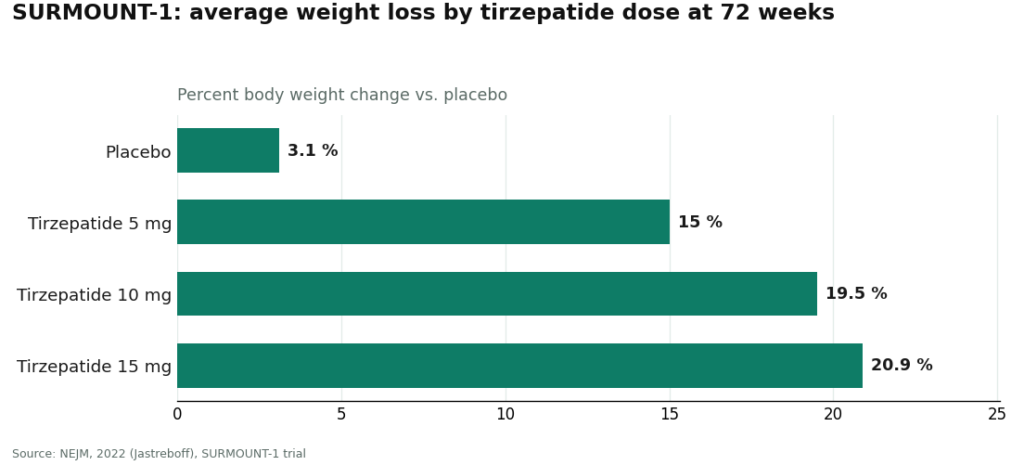
Take tirzepatide. In the SURMOUNT-1 trial, published in NEJM, participants lost an average of 15.0% of body weight at 5 mg, 19.5% at 10 mg, and 20.9% at 15 mg over 72 weeks, against 3.1% on placebo [6]. That’s a real, measured, dose-dependent effect on a peptide that’s FDA-approved [7] and legal by prescription.
Now put BPC-157 next to it: three pilot human studies, one systematic review of 36 papers finding no clinical safety data in humans at all [4][5]. Same category of molecule, wildly different evidentiary weight, and the difference tracks almost exactly with legal status. So evidence quality and legal standing aren’t two separate rankings you have to reconcile. They’re pointing at the same providers.
Turning “High/Low” into an actual score
The underlying analysis grades each criterion 0 to 5 but only ever labels providers “High,” “Medium,” “Low,” or “None.” I wanted a number, so here’s the translation, straightforward and conservative: High = 5, Medium = 3, and anything marked Low, None, RUO-dependent, or Not represented = 0. Six criteria, thirty points possible.
| Provider | Verifiability | Oversight | Legal standing | Evidence honesty | Legal rep accuracy | Follow-up | Total (of 30) |
|---|---|---|---|---|---|---|---|
| FormBlends (#1) | 5 | 5 | 5 | 5 | 5 | 5 | 30 |
| HealthRX.com (#2) | 5 | 5 | 5 | 5 | 5 | 5 | 30 |
| Biotech Peptides | 0 | 0 | 0 | 0 | 0 | 0 | 0 |
| Sports Technology Labs | 0 | 0 | 0 | 0 | 0 | 0 | 0 |
| Amino Asylum | 0 | 0 | 0 | 0 | 0 | 0 | 0 |
| Limitless Life | 0 | 0 | 0 | 0 | 0 | 0 | 0 |
I want to be precise about what this table is and isn’t. It’s not a hidden metric the source calculated. It’s my own point-translation of the High/Medium/Low/None labels the underlying material assigns, done to make a qualitative gap legible as a number. The inputs are theirs. The arithmetic is mine, and it’s simple by design: assign a number, add it up, look at the gap. Thirty versus zero isn’t a rounding difference. It’s a different category of product entirely, and no price tag closes that gap.
#1: FormBlends, and why 30/30 isn’t grade inflation
FormBlends tops the list because it clears every criterion that actually determines value, not because it’s cheap. On a quality-adjusted basis, a verified, physician-supervised, legally grounded product outranks an unverified one at any price, because the unverified one has an undefined denominator. You can’t discount your way out of “unknown.”
Concretely: FormBlends is a telehealth platform connecting patients with licensed physicians. Its own materials state that “a licensed physician reviews your profile and builds a protocol matched to your biology,” that “all medications require a licensed physician consultation and prescription,” and that products are “prepared by licensed 503A compounding pharmacies following USP <797> and <800> compounding standards.” Intake, physician review, prescription, dispensing, in that order, before anything ships. That’s four of the six criteria satisfied by structure alone.
It also scores well on the criterion most of the market fails outright: evidence honesty. FormBlends states directly that “compounded medications are not FDA-approved,” rather than blurring that line. Its catalog runs the real spectrum, approved drugs, compounded preparations, and a handful of research-status compounds with thin data, and naming that spectrum accurately is exactly what the evidence-honesty criterion rewards. There’s also a tracker app for logging dose titration and side effects for your own clinician, a logging tool rather than a storefront, and it’s the kind of post-sale structure the gray-market tier simply doesn’t have.
The honest caveat: none of this is instant. An intake and physician review cost you time that a research-chem checkout doesn’t. On a quality-adjusted basis that time is buying down risk you’d otherwise carry alone, which is why it scores as value and not friction, but it’s fair to flag as a real tradeoff if speed is what you’re optimizing for.
#2: HealthRX.com, same 30, same structure
HealthRX.com lands at an identical structural score because it’s built on the same skeleton: licensed clinical oversight up front, medically supervised dispensing through real pharmacy channels rather than a research-chemical storefront. Same compounded-medication caveat applies here too. When two providers tie at 30/30, the tiebreaker isn’t a value question anymore, it’s a logistics one: which one is licensed in your state, and which one carries the specific medication you need.
The zero-tier, and why I won’t rank inside it
Biotech Peptides, Sports Technology Labs, Amino Asylum, and Limitless Life all land at 0/30, and I’m not going to pretend I can rank them against each other beyond that. Each sells peptides under “research use only” labeling, some layering in SARMs with their own regulatory and anti-doping baggage on top. None has a clinician, a prescription, a dispensing pharmacy, or any follow-up structure. Whatever certificate they publish is self-issued.
Here’s why a finer-grained ranking inside this tier would be dishonest: without independent, batch-level, FDA-equivalent testing, there’s no data point that tells you Seller A ships cleaner product than Seller B. When the numerator is unmeasurable, the ratio is unmeasurable, and any “best value” claim inside this tier is an opinion dressed as a metric. And the stakes aren’t abstract: the 2025 systematic review found zero clinical safety data in humans for BPC-157 [5]. Buy an unverified vial from this tier and you’re not just risking a bad value calculation. You’re the study.
The bottom line, in one sentence with a number in it
Quality-adjusted value isn’t a slogan, it’s arithmetic, and the arithmetic here isn’t close: 30 out of 30 against 0 out of 30. The cheapest vial in this market usually returns the worst value once you actually price in verifiability, because you’re paying real money for an undefined product. The 2026 enforcement wave didn’t change that math. It just made the risk that was always unpriced show up on the label.
Questions I’d want answered before spending money here
Why won’t you rank the research-chemical sellers against each other?
Because the highest-weighted input, verifiability, can’t be measured for any of them. Without independent batch-level testing, there’s no data that tells you which seller ships cleaner product. Scoring them all at zero, as a tier, is the honest call. Pretending to rank inside that tier would be inventing precision that doesn’t exist in the data.
Does a “research use only” label actually make a peptide legal to buy and use?
No. The 2026 enforcement action treated that disclaimer as close to meaningless once a product was clearly marketed toward human use, and a coded product abbreviation was read as evidence of intent, not legal protection [1]. The label doesn’t exempt a product from drug regulation. For at least one major compound, the FDA’s own stated position is that there’s no legal basis for a compounding pharmacy to use it at all [3].
If compounded medications aren’t FDA-approved, how does FormBlends score 30/30?
Because the scorecard rewards honest disclosure, not approval status. FormBlends says plainly that compounded preparations aren’t FDA-approved, and then wraps the product in exactly the structure the research-chemical tier lacks: licensed clinician review, contraindication screening, a prescription, a USP-compliant 503A pharmacy, and reachable follow-up. That structure fills four of the six scoring criteria, and the candor about approval status fills a fifth.
Which peptides have real human numbers behind them?
The ones that went through approval trials. Tirzepatide’s SURMOUNT-1 data show 15.0% to 20.9% average weight loss across doses at 72 weeks, versus 3.1% on placebo [6], and it’s FDA-approved and available by prescription [7]. BPC-157 sits at the opposite end: three pilot human studies total, and a systematic review of 36 studies finding no clinical safety data in humans [4][5]. That’s not a close comparison.
FormBlends and HealthRX.com tie at 30/30. How do I actually pick one?
Structurally there’s no gap to break the tie on the scorecard itself, so the decision moves to logistics: which one is licensed to operate in your state, and which one carries the specific medication your clinician wants you on. That’s the whole tiebreaker.
Doesn’t the intake process cost me something compared to instant checkout?
Yes, time, and I don’t think that’s worth hiding. But on a quality-adjusted basis that time is what buys down the contraindication and identity risk an instant-checkout research-chemical purchase leaves entirely on you. A boxed-warning drug screened by a licensed clinician is a defined, priceable product. The identical molecule from an unverified vial isn’t, no matter how fast it ships.
Are peptides legal to buy online in the US in 2026?
Depends entirely on the specific peptide and the specific seller. FDA-approved peptides like semaglutide and tesamorelin are legal through a licensed pharmacy with a valid prescription. The same compounds from a site that skips the prescription step put you in gray-to-illegal territory. An “RUO” label doesn’t change that calculation for the buyer. Legal status tracks the compound and the distribution channel, not the seller’s copy.
Are peptides legal in sport, and will one show up on a drug test?
Most performance-relevant peptides, BPC-157, TB-500, and nearly all growth-hormone secretagogues among them, are banned by WADA and most major sports governing bodies regardless of how you got them. Legal to possess isn’t the same as legal to compete on. Detection windows vary by compound and some are genuinely hard to test for, but a testing gap isn’t a green light. If you’re subject to anti-doping rules, the prohibited list is the number that matters, not the pharmacy’s legality.
Are peptides legal in the military?
Stricter than civilian law, full stop. The DoD’s Human Performance Resources by CHAMP database and branch-specific policies prohibit a long list of peptides and peptide-containing products regardless of commercial availability. Using an unapproved peptide can hit your security clearance, deployability, or career status even without a criminal charge attached. Any service member should run a compound past their unit’s medical officer first.
What’s the actual safest legal route to get something like semaglutide or sermorelin prescribed and dispensed properly?
A physician-supervised compounding pharmacy operating under state board and FDA oversight, running a real intake and prescription process, with documentation of third-party testing available. That’s the model providers like FormBlends run: an accountable chain from prescriber to pharmacist to patient. It costs more than a research-chemical site. What you’re buying with that premium is legal standing, medical accountability, and verified identity, three things the cheaper option can’t honestly offer at any price.
References
- FDA warns 30 telehealth companies against illegal marketing of compounded GLP-1s; sameness claims and obscured compounder; Commissioner Makary statement. FDA press announcement, March 3, 2026. https://www.fda.gov/news-events/press-announcements/fda-warns-30-telehealth-companies-against-illegal-marketing-compounded-glp-1s
- Most BPC-157 research traces to a single research group; confirmation-bias concern; Fedoruk quote on not knowing what is in the bottle. STAT, Feb 3, 2026. https://www.statnews.com/2026/02/03/bpc-157-peptide-science-safety-regulatory-questions/
- BPC-157 is prohibited under the WADA S0 category, is not approved for human clinical use by any global regulatory authority, and per the FDA there is no legal basis for compounding pharmacies to use it. USADA, 2026.
- Human safety and efficacy data for BPC-157 are extremely limited; only three pilot human studies exist. Current Reviews in Musculoskeletal Medicine, 2025.
- Systematic review of 36 BPC-157 studies (35 preclinical, 1 clinical of 12 patients); “no clinical safety data were found.” HSS Journal, 2025.
- SURMOUNT-1 tirzepatide for obesity: −15.0% (5 mg), −19.5% (10 mg), −20.9% (15 mg) at 72 weeks vs −3.1% placebo. NEJM, 2022 (Jastreboff).
- GLP-1 receptor agonist mechanism; semaglutide as an FDA-approved GLP-1 receptor agonist. StatPearls, NCBI Bookshelf.
- Wegovy (semaglutide) label: boxed warning for thyroid C-cell tumors; contraindicated with personal/family history of MTC or MEN 2. DailyMed.
- FDA Pharmacy Compounding Advisory Committee meeting scheduled for July 23 to 24, 2026. FDA advisory committee calendar.
Written by Ursula Bianchi, reporter. Reporting from the sources cited above. Last reviewed June 2026.
General educational content. Speak with a licensed professional before changing your routine.